
The Complete Guide to Mobile Billboard Advertising
How Mobile Billboard Trucks Drive Real-World Traffic and Sales
In an increasingly crowded digital world, advertisers are rediscovering the power of physical, real-world visibility. While online ads are easily ignored, skipped, or blocked, mobile billboard advertising delivers brand messages directly into high-traffic environments where real people live, work, shop, and socialize.
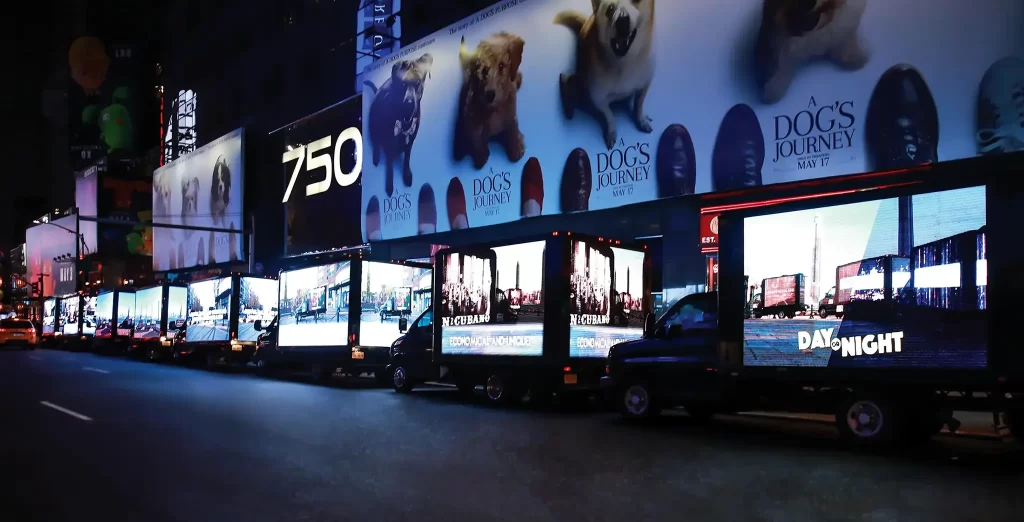
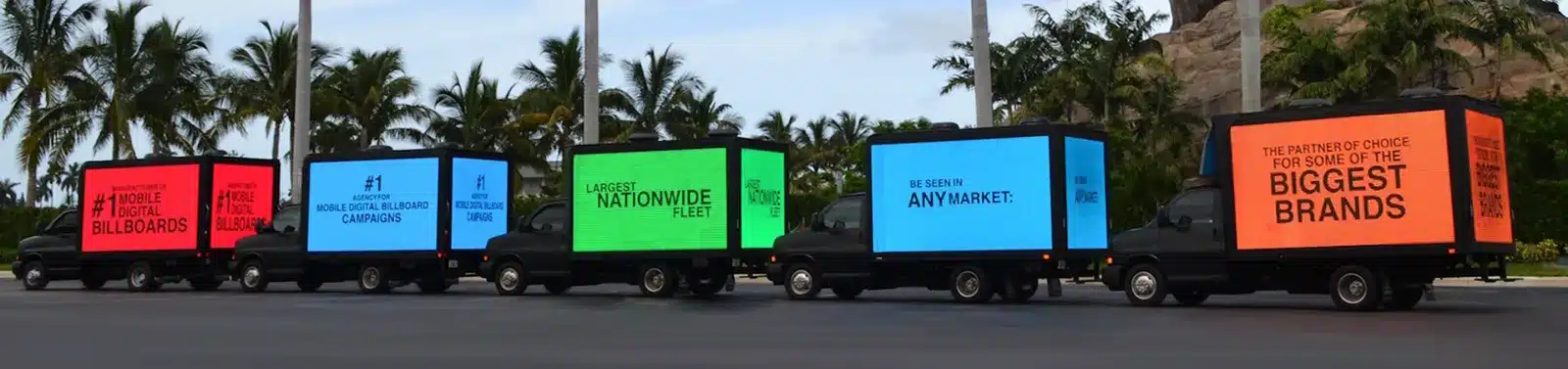
Mobile billboard advertising, also known as digital LED truck advertising, combines large-format digital displays with the mobility of vehicles. The result is one of the most flexible and high-impact forms of out-of-home (OOH) advertising available today.
This guide explains how mobile billboard advertising works, how campaigns are structured, what it costs, and how to maximize ROI. If you’re planning a campaign in California, see our local market pages for San Francisco mobile billboard advertising and Los Angeles mobile billboard advertising.
What Is Mobile Billboard Advertising?
Mobile billboard advertising is out-of-home advertising delivered by street-legal vehicles equipped with large digital LED screens that display ads while driving through targeted locations. Campaigns can be routed in real time and supported with GPS reporting for proof-of-performance.
Unlike traditional static billboards, mobile billboard trucks:
- Travel through specific neighborhoods, districts, and venue corridors
- Can pause briefly in high-visibility areas (where permitted)
- Display full-motion video and static images
- Support campaign adjustments based on timing and foot traffic
- Provide GPS tracking and reporting
Most modern digital LED billboard trucks feature:
- Dual-sided or tri-sided LED displays
- Daylight-readable brightness
- HD or near-HD resolution
- Optional audio capability (market dependent)
- Professional operations and technical support
Why Mobile Billboard Advertising Works
If you want the short version, mobile billboards work because they deliver high-visibility messaging in the real world with targeted routing and measurable reporting.
It Cannot Be Skipped or Blocked
- No ad blockers
- No skip buttons
- No feed algorithms
- No impression fraud
It Reaches People in High-Intent Locations
Mobile billboards can be routed through:
- Shopping districts
- Entertainment and nightlife zones
- Convention centers and hotel corridors
- College areas
- Tourist zones
- Stadiums and arenas
- Business corridors and commuter routes
It Creates Visual Dominance
A large digital LED display moving through traffic is difficult to ignore. People notice it, remember it, and often photograph or share it.
It Builds Brand Trust
Large-format outdoor advertising signals legitimacy. For many brands, it increases response rates across search and social because the audience recognizes the name when they see it again.
It Complements Digital Marketing
Mobile billboard advertising performs best when paired with:
- Search ads
- Paid social
- Retargeting
- Event marketing
- Product launches
Types of Mobile Billboard Campaigns
1) Event-Based Campaigns
Built for high-density exposure around conferences and major events. Trucks circulate around venues, adjacent hotels, restaurants, and high-traffic entry routes.
2) Geographic Targeting Campaigns
Designed to dominate specific neighborhoods, cities, and regions. This is ideal for retail, automotive, healthcare, and services where customer location matters.
3) Brand Awareness Campaigns
Optimized for reach and frequency over multiple days or weeks.
4) Competitive Conquesting
Targets customers near competitor locations, adjacent routes, and high-intent commercial zones.
5) Political and Advocacy Campaigns
Used for public messaging, awareness, and turnout strategies.
How Mobile Billboard Campaigns Are Planned
- Audience analysis: define who you want to reach and where they physically are.
- Route development: plan around traffic flow, pedestrian density, and visibility zones.
- Creative optimization: design for distance, motion, and fast comprehension.
- Scheduling: align operating hours with peak activity windows (commute, lunch, nightlife, event schedules).
- Monitoring: use GPS reporting and operational oversight to ensure delivery quality.
For California campaigns, market-specific routing matters. If your campaign is focused on core business corridors and major events, review our local pages for San Francisco and Los Angeles.
Creative Best Practices for Mobile Billboards
Use these guidelines to improve ad recall and response:
- One message per screen: keep the idea singular.
- 6–10 words max: write for a 5–10 second read window.
- Large typography: prioritize distance readability.
- High contrast: clarity beats design complexity outdoors.
- One call-to-action: website, QR, or short offer.
- Video pacing: hold key frames long enough to read (commonly 7–10 seconds per message).
Measuring Performance and ROI
Impressions
Estimated using traffic counts, pedestrian data, and time-in-zone exposure assumptions. Quality operators can explain the methodology clearly.
GPS Proof-of-Performance
Most professional campaigns include GPS reporting such as route maps, timestamps, and dwell points to document delivery.
Engagement and Response
- QR scans and landing page visits
- Custom URL traffic
- Call tracking numbers
- Promo code usage
- Lift in branded search volume
Cost of Mobile Billboard Advertising
Mobile billboard advertising costs vary by market size, duration, daily hours, number of trucks, routing complexity, and event density. In general, smaller markets trend lower four figures, mid-size markets mid four figures, and major metros or major event weeks can be higher four to five figures depending on scale.
What Quality Providers Typically Include
- Truck and trained driver
- Fuel and maintenance
- Routing and operational oversight
- GPS tracking and proof-of-performance reporting
- Compliance and local regulation handling
- Technical support for screen playback
Regulatory and Compliance Considerations
Mobile billboard trucks operate under local traffic, parking, and signage rules. Experienced operators manage dwell timing, permissible zones, and any required permitting to keep campaigns running smoothly.
Mobile Billboards vs Other Advertising Channels
Mobile vs Static Billboards
| Feature | Mobile | Static |
|---|---|---|
| Mobility | Yes | No |
| Geographic targeting | High | Low to medium |
| Creative updates | Fast | Slow |
| Flexibility | High | Low |
Mobile vs Digital Ads
| Feature | Mobile | Digital |
|---|---|---|
| Ad blocking | None | Common |
| Visibility | High | Variable |
| Fraud risk | None | Present |
Who Should Use Mobile Billboards?
- Technology and SaaS companies
- Retail and QSR chains
- Automotive dealers
- Healthcare providers
- Universities
- Hospitality and entertainment brands
- Real estate developers
- Political and advocacy organizations
Common Mistakes to Avoid
- Overloading creative: too much text reduces recall.
- Poor routing: random driving wastes budget.
- Choosing inexperienced vendors: inconsistent delivery and weak reporting.
- No integration: campaigns perform best alongside search, social, and PR.
- Weak planning: success requires operational strategy, not just screen time.
Why Experience Matters
Mobile billboard advertising is operationally complex. Consistent outcomes require regulatory knowledge, traffic expertise, driver training, technical reliability, and real-time campaign oversight.
The Future of Mobile Billboard Advertising
- Higher-resolution displays
- Data-driven targeting and routing
- Real-time creative updates
- Integration with mobile retargeting
- Smarter optimization based on performance windows
How to Launch a Successful Mobile Billboard Campaign
- Define objectives: awareness, event visibility, leads, or foot traffic.
- Select markets: match routing to where your customers actually are.
- Build outdoor-ready creative: simple, high-contrast, one message.
- Choose an experienced operator: consistency and compliance matter.
- Integrate channels: support with search, social, and retargeting.
- Measure and improve: use reporting to refine future campaigns.
Conclusion
When executed correctly, mobile billboard advertising delivers high visibility, strong recall, geographic precision, brand credibility, and measurable performance. For brands competing for attention in real-world environments, LED billboard trucks remain one of the most effective OOH channels available.
Ready to Plan a Mobile Billboard Campaign?
Billboard Express runs professional mobile billboard campaigns with routing strategy, experienced drivers, and GPS proof-of-performance. If you’re planning a campaign in California, start with our local market pages for San Francisco and Los Angeles.
What you’ll get
- Market-aware routing and scheduling
- Digital LED screen playback support
- GPS tracking and proof-of-performance reporting
- Clear creative specs and guidance
Next steps
- Share your market(s), dates, and daily hours
- Send your creative, or we’ll provide formatting guidance
- We’ll confirm routing approach and availability
Request pricing and availability: Add your contact form shortcode/button here, or link to your quote page.